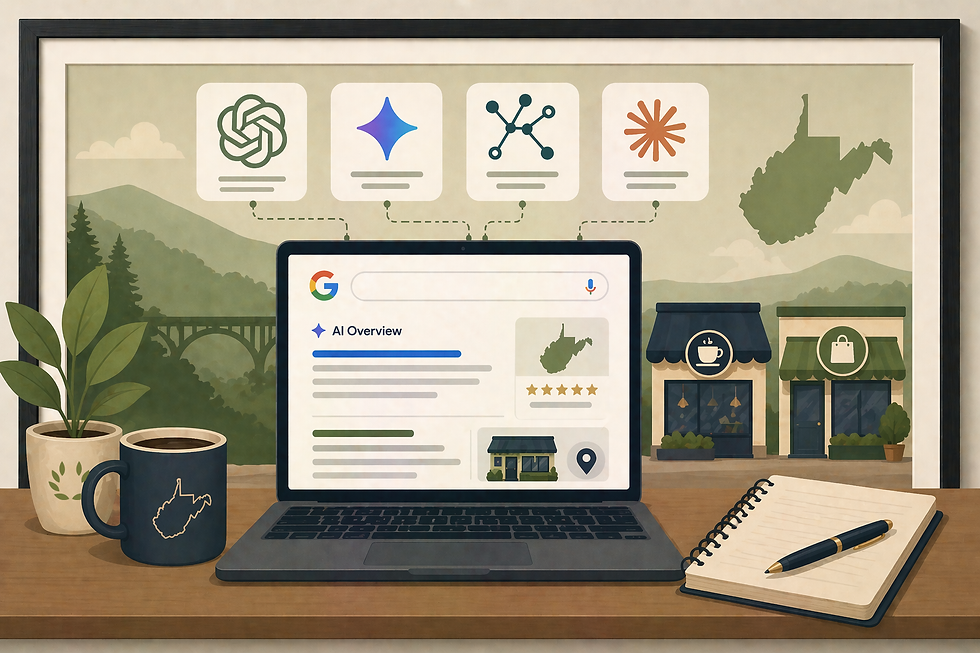
Google’s New AI Search Guide: What Businesses Owners Need to Know

Google recently published official guidance on how website owners should think about visibility in its generative AI search features, including AI Overviews and AI Mode. For small business owners, this is worth paying attention to because there is a lot of noise right now around “AI SEO,” “AEO,” “GEO,” and how traditional SEO fits into the puzzle.
The good news is that Google isn't saying you need to throw away everything you know about SEO and start over. The bigger message is more practical. SEO still matters. Useful content still matters. Technical structure still matters. Your website still needs to be clear, crawlable, trustworthy, and helpful to real people. Google says its generative AI features are rooted in its core Search ranking and quality systems, which means the foundation of SEO still applies.
For small businesses, that should be reassuring. You don't need to chase every new AI search gimmick. But you do need to take your website, content, and online presence seriously because generic content is becoming easier to ignore.

Key Takeaways
Google says SEO is still relevant for generative AI search.
AI Overviews and AI Mode still rely on Google’s Search index and ranking systems.
Useful, original, people-first content matters more than generic content.
Technical SEO still matters because Google needs to crawl, understand, and index your pages.
Local business details and Google Business Profiles can still help businesses appear in Search and AI experiences.
You do not need special AI files, special AI markup, or awkward content formatting just to be visible in Google AI search.
Search Console is becoming more important for understanding AI search visibility.
The smartest move is to improve your website SEO, not chase shortcuts.
What Google Is Saying About AI Search
Google’s guidance is not a secret formula for ranking in AI search. It is more of a reality check. Google is telling website owners that generative AI search is still connected to the broader search ecosystem. Your content still has to be found, understood, evaluated, and trusted before it has a chance to appear in meaningful search experiences.
What does Google’s AI search guidance mean for small businesses?
For small businesses, the takeaway is simple. The goal is not to trick AI into mentioning your company. The goal is to build a website that clearly proves what you know, what you offer, who you help, and why your content is worth trusting.
That has always been good SEO. AI search just makes weak content easier to spot. If your website is thin, vague, outdated, or filled with generic blog posts, it has less to offer. If your website is useful, specific, organized, and grounded in real experience, it has a much stronger foundation.
Is Google AI search separate from regular SEO?
Not really. Google explains that its generative AI features use techniques like retrieval-augmented generation and query fan-out. In simple terms, Google uses its Search systems to gather useful information, explore related questions, and present answers with supporting links where appropriate.
That matters because AI search is not some separate universe floating away from regular Google Search. It may look different to the user, but the information still has to come from somewhere. If your website is not useful, clear, crawlable, and indexable, you make it harder for Google to use your content in any search experience.
SEO Is Getting More Demanding
Every time search changes, someone declares SEO dead. It happened with social media, voice search, featured snippets, and now AI search. But Google’s guidance points in the opposite direction. SEO still matters, but shallow SEO is losing value. The businesses that win will be the ones with clear websites, useful content, strong structure, and real trust signals.
Is SEO still important with AI search?
Yes. Google says its generative AI features are rooted in its core Search ranking and quality systems. That means content still needs to be discoverable, useful, and trusted before it has a chance to appear in Google’s AI search experiences.
The better way to say it is this: weak SEO is getting less useful. Thin blog posts, vague service pages, poor structure, and generic content are going to have a harder time standing out. A business that publishes useful content, explains its services clearly, answers real customer questions, and keeps its website technically healthy is still doing the kind of work that matters.
A strong SEO services strategy now needs to focus on clarity, usefulness, technical health, and content that actually helps people make decisions.
What kind of SEO matters most now?
The SEO that matters most now is the kind that helps both people and search engines understand your business. That means clear service pages, useful blog content, strong internal links, good page structure, technical health, and real trust signals.
A small business website should not make visitors work hard to understand what the company does. Your homepage should quickly explain who you help and how. Your service pages should answer the questions customers ask before they call. Your blog posts should solve real problems. If your content sounds like it could have been written for any business in any city, it probably needs more depth.
Generic Content Is Becoming Easier to Ignore
One of the strongest parts of Google’s guidance is its focus on valuable, non-commodity content. That is a fancy way of saying your content needs to bring something useful to the table. It shouldn't just repeat what every other website already says.
What does Google mean by useful content?
Google encourages website owners to create content with unique value, helpful examples, real experience, and a clear point of view. It warns against simply recycling what others have already said or publishing content that could easily be produced by a generative AI tool.
That should get every business owner’s attention. A blog post that says the same thing as a hundred other blog posts is not doing much for your brand or your SEO. Useful content should help the reader make a better decision, understand a problem more clearly, or take a smarter next step.
Why is generic content a bigger problem in AI search?
Generic content is a bigger problem because it is easy to replace. If your article only repeats the basics, Google has plenty of other sources that say the same thing. AI systems are especially good at summarizing common information, which means basic, recycled content has less room to stand out.
That doesn't mean every article has to be revolutionary. It does mean your content should include examples, practical advice, and a clear point of view. This is where small businesses can compete. You may not have the biggest website, but you can have the clearest and most useful answer for the audience you want to reach.
Technical SEO Still Matters in AI Search
Technical SEO is not the flashy part of search, but it is still essential. Google needs to be able to find, crawl, understand, and index your important pages. If your content is blocked, buried, duplicated, broken, or confusing, it has a much harder time performing in regular Search or AI-powered search experiences.
Does technical SEO still matter for AI Overviews?
Yes. Google says the way Search finds and processes pages remains central to how its AI systems access content. A page generally needs to be indexed and eligible to appear in Google Search with a snippet to be eligible for generative AI features. Google also says crawling, indexing, and serving are not guaranteed, even when a page follows the rules.
That may sound technical, but the practical takeaway is simple. Your important pages need to be accessible. They should not be buried, blocked, duplicated, broken, slow, or confusing. Your website should work well on mobile, make content easy to find, and use a structure that helps people understand the page.
Good website design is not just about how a site looks, it also affects structure, speed, mobile experience, navigation, and how easily visitors can find what they need.
Can Google use my content if my page is not indexed?
For Google’s Search features, indexing matters. If a page is not indexed, you should not assume it can help you in Search or generative AI search. That is why Search Console is so important. It helps you see whether your pages are indexed, whether Google can access them, and whether there are issues that need attention.
This is also why small businesses should not treat technical SEO as optional. A well-written article can still underperform if Google does not index it. A strong service page can still struggle if it is hard to crawl or disconnected from the rest of the site. Good content and good structure have to work together.
This is also why it helps to understand how web design impacts SEO and lead generation, because a better site supports both visibility and conversion.
Don't Chase Every AI Search Hack
This may be the most useful part of Google’s guidance for business owners. There are already a lot of people selling AI search shortcuts, special files, new acronyms, and complicated tactics. Some advice may be useful. Some of it will be a new label slapped on old SEO. Some of it will be nonsense.
Do I need special AI schema to rank in Google AI search?
No. Google says structured data is not required for generative AI search, and there is no special schema markup you need to add just for AI search. Structured data can still be useful as part of a regular SEO strategy because it can help with rich results, but it is not a magic AI visibility switch.
This is important because a lot of new AI SEO advice will sound urgent and complicated. If someone tells you there is a secret AI schema trick Google requires, be careful. The better move is to make your real pages stronger, clearer, and more useful.
Should I rewrite content just for AI search?
No. Google says you do not need to write in a special way just for generative AI systems, and you don't need to capture every long-tail variation of how someone might search. Google’s systems can understand synonyms and general meaning.
That doesn't mean structure is unimportant. Clear headings, focused sections, simple language, and helpful examples still matter because they help human readers. The key is to organize content for people first. If your page is easier for people to understand, it is usually easier for search engines to understand too.
What Businesses Should Update First for AI Search
The best response to Google’s AI search guidance is not panic. It is cleanup and improvement. Start with the pages that matter most to your business, then work outward. Your homepage, service pages, contact page, strongest blog posts, and top lead-generation pages should come before random new content.
Start with the pages that already have a job. For most small businesses, that means your homepage, service pages, contact page, strongest blog posts, and any pages that already bring in leads or traffic.
Don't start by creating a dozen new AI-focused blog posts. Start by improving the pages you already need people to trust. Make sure your services are clearly explained. Add examples. Answer common questions. Improve internal links. Make sure your calls to action are obvious. Check that your pages are indexable.
A good starting list looks like this:
Improve your main service pages.
Add original examples and practical insight.
Strengthen internal links between related pages.
Make sure important pages are indexed.
Keep your Google Business Profile accurate if you serve local customers.
Add useful images or videos where they support the page.
Remove or improve thin, generic content.
Use Search Console to watch performance.
The goal is not just more visibility, it is a stronger lead generation strategy that turns search traffic into calls, form submissions, appointments, and revenue.
How can I make my website more useful for AI search?
Make it more useful for people. That sounds too simple, but that's the correct filter to always remember. If a customer lands on one of your pages, can they quickly understand what you do, why it matters, and what they should do next? Does the page answer real questions, or just use cliché marketing language?
A useful website has clear service pages, helpful educational content, strong examples, simple navigation, internal links, and calls to action that make sense. It should help someone move from confusion to clarity. That's valuable whether the visitor came from regular Google Search, AI Overviews, social media, an email, or a referral.
Can local businesses appear in Google AI answers?
Yes. Google says generative AI responses can include information about local businesses where appropriate. Google also points to Google Business Profiles as one way to help business details appear across Google Search experiences.
For local businesses, this means the basics still matter. Your business NAP (name, address, phone number), services, hours, reviews, photos, categories, and website all need to be accurate. Your website should support your Google Business Profile by clearly explaining what you offer and where you serve customers.
If you serve customers in a specific area, it also helps to understand how local SEO works because AI search still depends on clear, trusted business information.
What local SEO signals still matter in AI search?
The same local trust signals still matter. A complete Google Business Profile helps customers and Google understand your business. Reviews show that real people have worked with you. Citations help confirm your business information across the web. Service pages explain what you do in more detail than a profile listing can.
A local contractor, dentist, restaurant, boutique, consultant, or home service company should not rely on one signal alone. Local visibility comes from the whole system. Your profile, website, reviews, citations, content, and internal links should all tell the same story.
Citations and search rankings are also connected because consistent business information helps search engines verify who you are, where you are, and what you do.
Customer reviews remain one of the clearest trust signals a local business can build, especially when people are comparing several options before contacting anyone.
[Internal link to customer reviews post, anchor text: customer reviews]
If you want a more practical starting point for local visibility, use this Local SEO Checklist alongside the recommendations from Google’s AI search guidance.
What This Means for Content Strategy
The days of publishing blog posts just to have activity on your website are fading. Content needs a job. Some content should answer customer questions. Some should support service pages. Some should build trust. Some should help people compare options. Some should attract early-stage searchers who are not ready to buy yet.
Should every blog post target AI search?
No. Every blog post should have a real purpose. The problem is not blogging. The problem is publishing content that has no purpose. If a post does not help your audience, support your services, connect to your site structure, or build authority, it probably needs to be improved or removed.
You do not need to chase every possible AI search variation. Google warns against creating lots of content just to manipulate rankings or generative AI responses. A high quantity of pages does not automatically make a website higher quality.
What makes content worth publishing now?
A post is worth publishing when it adds something useful. That might be your experience, your opinion, your process, your examples, your customer insight, or your ability to explain something clearly. It should not feel like a lightly rewritten version of what already ranks.
Before publishing, ask:
Does this answer a real question?
Does it add anything beyond common knowledge?
Does it reflect actual experience?
Is it clear who this is for?
Would a potential customer trust us more after reading it?
Is there a logical next step?
That last question matters. Content should not be a dead end. A helpful blog post should naturally connect to related articles, service pages, contact options, or deeper resources.
Final Thoughts
Google’s new AI search guidance should calm business owners down, not scare them. The message is not that SEO is dead. The message is that SEO needs to be useful, clear, technically sound, and built around real people.
That is good news for small businesses willing to do the work. You don't need to out-publish every competitor. You don't need to create fake authority or stuff your website with awkward search variations. You need a website that explains your value clearly, content that helps your audience, technical structure that Google can understand, and a strategy that connects visibility to real business growth.
AI search is changing Google, but it's not changing the need for trust.
The businesses that win will likely be the ones that stop treating SEO like a trick and start treating it like a long-term asset. Clear service pages. Helpful content. Strong local signals. Better internal links. Real experience. Better measurement. Fewer shortcuts.
It's not a new game. It's just better SEO.
When Expert Guidance Helps
You can make many of these improvements on your own, especially if you are willing to review your website honestly and improve one page at a time. But if your SEO, website content, Google Business Profile, and lead generation strategy feel disconnected, expert help can save a lot of time.
If your SEO, content, website, and follow-up process feels scattered, an experienced, professional digital marketing consultant can help you decide what to fix first. A boutique SEO and digital marketing partner like Relaunch Digital can help you build the right foundation for modern search, including AI search. That means stronger service pages, better content, cleaner structure, smarter internal links, and a website built to earn trust before the first conversation.